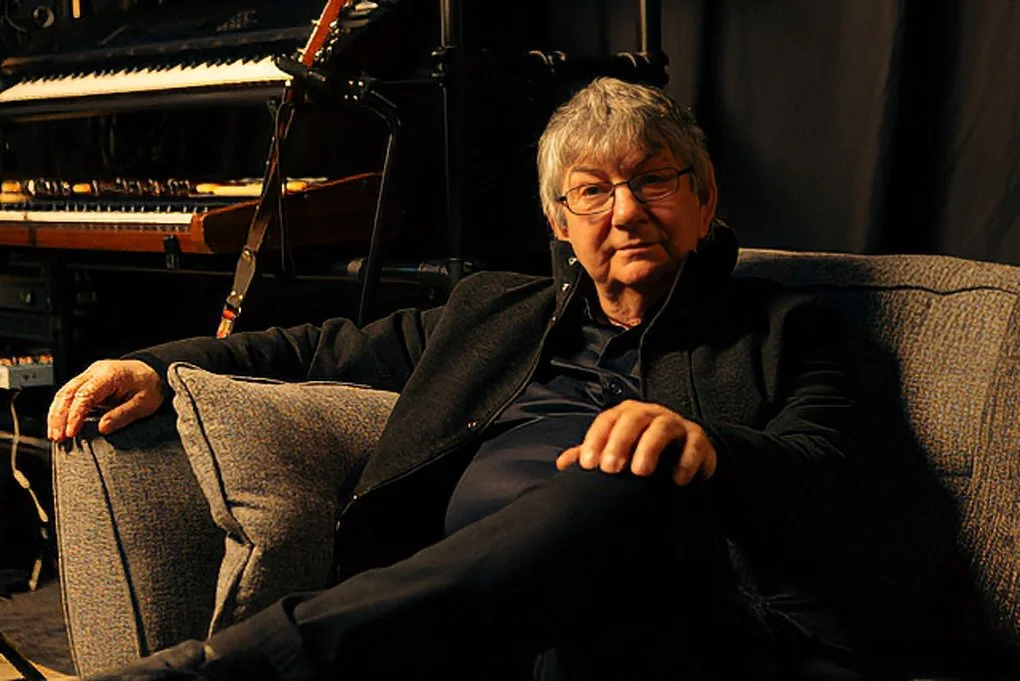
Duncan Stuart Mackillop Biographie
It was the bright lights that first caught his attention, quickly followed by the music, especially the sound of his mother’s voice. He didn’t know it then, nestling in his crib, but the magic of the stage would come to be his constant companion through life.
Once MacKillop had learned to walk and talk, piano lessons quickly followed. Grades One and Two fell easily; by Three he was sight reading quickly enough to digest an entire score just two bars into the piece. His precocious talents did not impress Ms Smilie, his teacher, “He’ll never come to anything in music with that attitude,” she pronounced. Maybe she recognised the limitations of her own abilities? He harboured other passions, Geology with its unimaginable timescales fascinated him, and later, at fifteen he joined the Dunoon Archaeological Society, regularly going on ‘digs’. But music took precedence with MacKillop forming the band Joe Cool while still a teenager.
By his 21st birthday he had a new band, Cado Belle, and just released their first eponymously titled album. A fusion of pop and soul, the album already showed signs of his talents with composition: books on orchestration and biographies of the romantic era composers weighed heavy on his luggage as the band hit the road. Poorly supported by their record label, Cado Belle experienced mixed fortunes. Sometime in 1978 they played a gig at Leicester University with the Boomtown Rats in support, only to return a month later but this time it was they who supported the ‘Rats. The lethal combination of Punk and misfortune heralded his band’s demise - Mackillop took it personally. “It made me feel I’d let the band down”.
Pete Edmunds, the man who supplied all Cado Belle’s touring needs, lighting and sound, offered the despondent MacKillop a job. Edmunds was about to produce Mike Oldfield's first ever tour. Riding high on the success of Tubular Bells, Oldfield needed someone to look after all his synthesisers, temperamental instruments ill-suited to being pulled daily in and out of trucks. “Thanks for the offer, Pete, but I’m a musician.” He said. It pays £230 per week, countered Edmunds. A lot of money in those days, MacKillop needed no further encouragement: “I’m your man.”
While the money was great, the disillusionment of forsaking his performing career, compounded by the move to back-stage - a ‘mere technician’ - sealed what was to be MacKillop's ultimate undoing. Though he did the job very well, what he lacked in self-esteem was concealed with the aid of the bottle. But because he was successful in the role, tour offers followed year after year. Abba was a high point, many bands of that calibre followed. He travelled the world, repeatedly. But by 1986 he was in serious trouble, drinking half a bottle of vodka for breakfast. Sent home from a US tour in disgrace he fell upon the good nature of his old Cado Belle band mate, Maggie Reilly who promptly signed him into a rehab’ clinic on the Kings Rd that specialised in people from the music industry. He had barely enough money for a weekend there: “Would you like to go to an Alcoholics Anonymous (AA) meeting?” they suggested, and he agreed. As all alcoholics discover, AA is not populated with sad old derelicts and street dwellers lost to society, it's full of people just like us, bankers and bin men, board members and bus drivers; people who have cast themselves adrift in an ocean of booze. MacKillop really liked it. “It was only later I realised how close to death I had come,’ he said. Attending meetings daily, he celebrated forty years sober in June 2026 and still goes regularly.
Witnessing MacKillop’s recovery and having herself secured a new contract with a German Record label (Mambo Music) Reilly asked if MacKillop would help her with the songwriting, she would supply the lyrics, he the music. “It was a living, and it was a return to my true self,” he said later. “Not a roadie doing it for the money, but a musician doing it for the love of music. It gave me stability and space to indulge the things that truly stimulated me, particularly composition - I had an attic full of DAT tapes and cassettes I’d filled during my roadie days - and also, a return to archaeology believe it or not.” Visiting prehistoric sites all over the UK and eventually Scandinavia and North America, he even managed to fit this passion into his physical rehabilitation, taking up Orienteering, a form of extended cross-country running involving essential skills in navigation with map and compass. “I discovered it was a bit of me I had been looking for all my adult life.”
In those early days of sobriety and drawing upon those treasured tapes he made his first stab at classical composition. Though he stumbled repeatedly, the fact he didn’t have a single musical qualification beyond Grade Two piano only made him want to try harder. And as with orienteering, he found his own compass through his love of the Romantic era composers. The Prairie Suite is the blossoming of all those influences.
Finally, I’ve made peace with that fifteen-year-old budding archaeologist, that fundamental part of me that had been absent for so long. Feeling complete, I revisited the thing that had stimulated me most; the great trek of the pioneers across the Western US. I know, superficially the European Romantic era and the Wild West appear to have little in common, but the landscape is magical, the archaeology rich and fertile, and the people heroic: who could fail to be inspired by that?